Slides 30–38
Use case 1: Professional services engagement launch
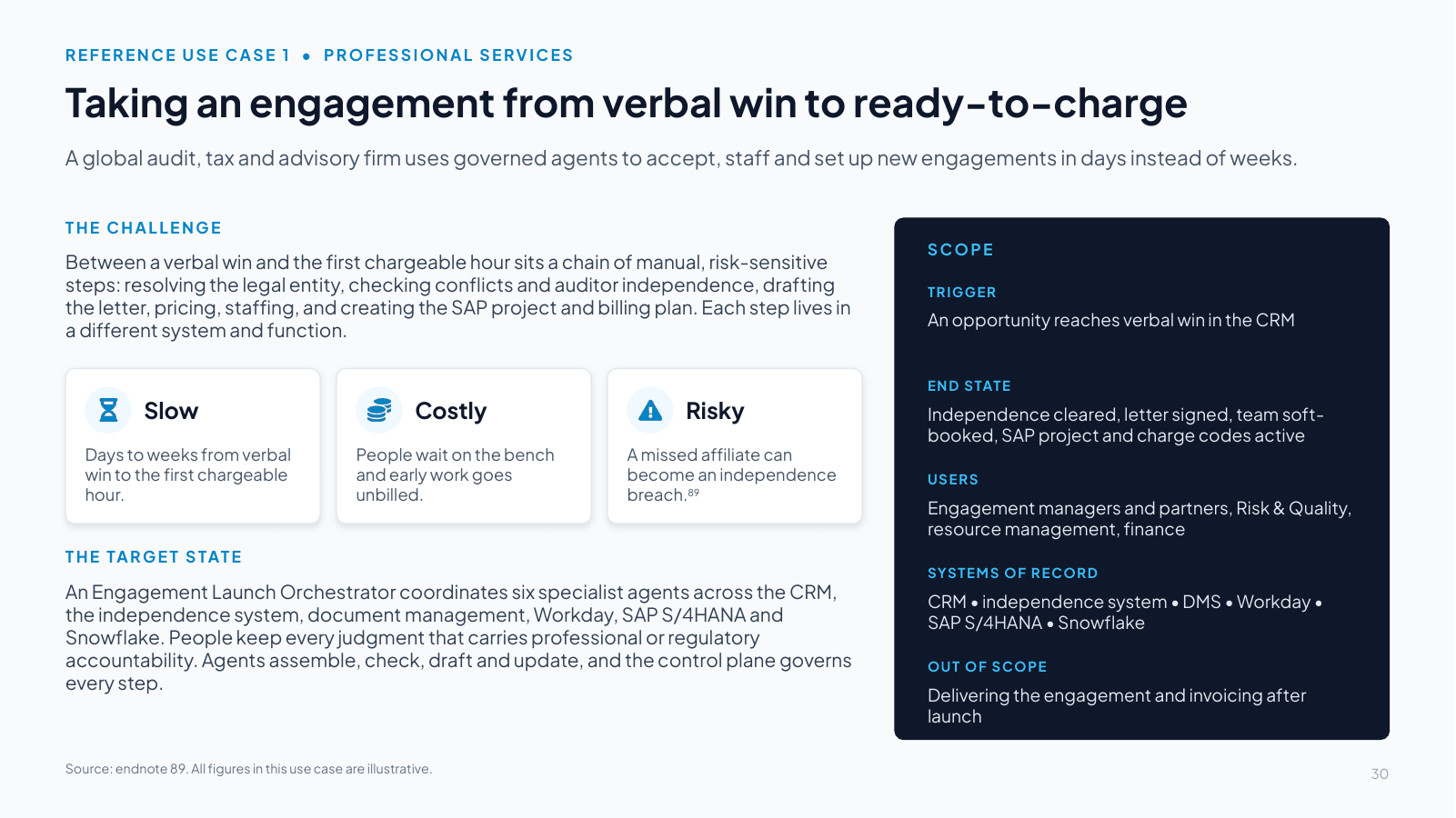
Taking an engagement from verbal win to ready-to-charge
Speaker notes
Talk track (two minutes): This is the first of three reference use cases that show the control plane working end to end on a real process. It is written for a global audit, tax and advisory firm, and the architecture is vendor-neutral except for the transactional systems the process already runs on: a CRM, SAP S/4HANA, Workday and Snowflake.
The problem: between a verbal win and the first chargeable hour sits a chain of manual, risk-sensitive steps owned by different functions in different systems. Delays leave people on the bench and let early work go unbilled, and a missed affiliate relationship can become an auditor-independence breach, with regulatory consequences, when the client or its parent is an audit client [89].
In the target state, an Engagement Launch Orchestrator coordinates six specialist agents: Entity Resolution, Conflicts & Independence, Scoping & Letter, Pricing & Budget, Staffing and Engagement Setup. People keep every judgment that carries professional or regulatory accountability (independence decisions, engagement terms, partner approval). Agents do the assembly, checking, drafting and system updates, and the control plane makes every step governed, observable and auditable.
All figures in this use case are illustrative. Replace them with the firm's own baseline during discovery. The companion handbook (Section 11) has the full detail.
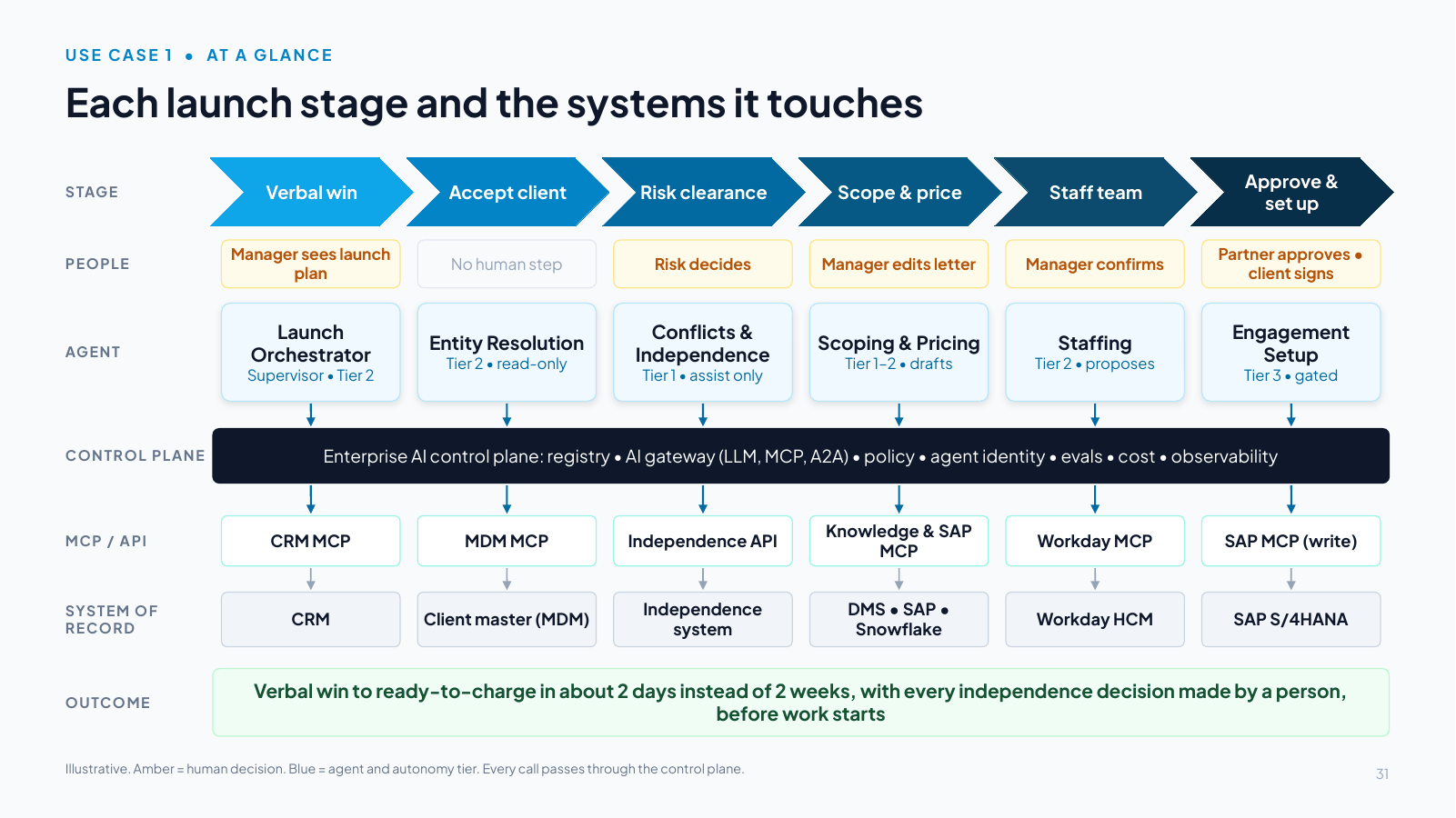
Each launch stage and the systems it touches
Speaker notes
Walk the six stages left to right. For each, point to the human step (amber), the agent and its autonomy tier (blue), and the governed path underneath: every agent reaches its system of record only through the control plane and a governed MCP tool or API.
- Verbal win: the CRM event starts the Launch Orchestrator, which posts a launch plan to the engagement manager.
- Accept client: the Entity Resolution agent matches the client to its MDM golden record and corporate hierarchy (read-only).
- Risk clearance: the Conflicts & Independence agent assembles findings and precedent. Risk & Quality decides (Tier 1).
- Scope & price: the letter is drafted from approved clauses. The budget comes from SAP rate cards and Snowflake actuals. The manager edits.
- Staff team: a proposal from Workday skills and availability plus a yes/no independence-clearance flag. The manager confirms.
- Approve & set up: partner approval and client signature open the gate. Only then does the Setup agent write to SAP S/4HANA (Tier 3, policy-gated).
The outcome to land: verbal win to ready-to-charge in about two days instead of two weeks (illustrative), with every independence decision made by a person, before work starts, with evidence attached.
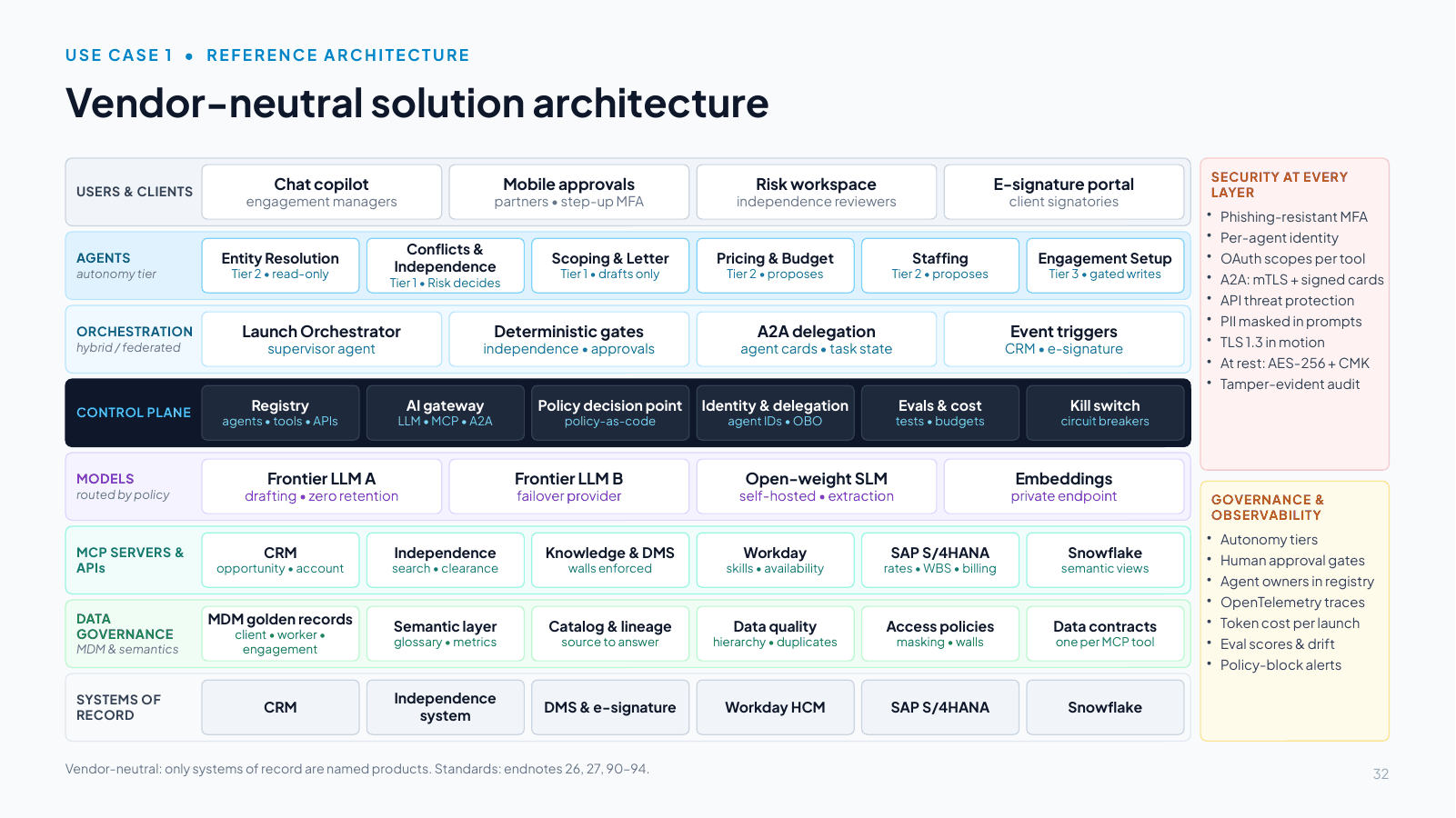
Vendor-neutral solution architecture
Speaker notes
This is the vendor-neutral solution architecture, aligned to the north-star reference architecture. Only the systems of record are named products. Everything else is replaceable.
Orchestration model selected: hybrid/federated. The control plane governs identity, policy, cost and audit centrally, while Risk & Quality, Finance and Talent own their agents. Within a launch, a supervisor pattern applies: the orchestrator delegates tasks to specialist agents over A2A [27], and agents reach tools and data only through MCP servers [26]. The regulated sequence is deterministic and does not depend on model reasoning: no letter before independence is cleared, no SAP write before partner approval and client signature.
Models and routing: a frontier model under enterprise terms with zero data retention drafts letters and summarizes findings, with a second provider for failover. A self-hosted open-weight small language model handles extraction, classification and personal-data detection, and embeddings run on a private endpoint. The AI gateway sends client-confidential payloads only to private models or approved regions and sets token budgets per launch.
Data governance covers client and legal-entity, worker and engagement golden records and a semantic layer (glossary, metric definitions and a data contract for each MCP tool). A catalog with lineage lets a reviewer see which records drove an independence finding, and access policies enforce masking and information barriers between engagements.
Security at every level: the design follows zero-trust principles [90] and gives each agent instance a unique workload identity [91]. A2A calls use on-behalf-of token exchange with narrowed scopes [92]. MCP servers are OAuth-protected, with per-tool scopes and no token pass-through [26], and as firm practice their tool definitions are reviewed and pinned. The design also uses prompt-injection screening and output validation [93]. Data at rest uses AES-256 with customer-managed keys, and data in motion uses TLS 1.3 and mTLS.
Observability: every hop emits OpenTelemetry traces using the generative-AI semantic conventions, tied to one engagement correlation ID [94].
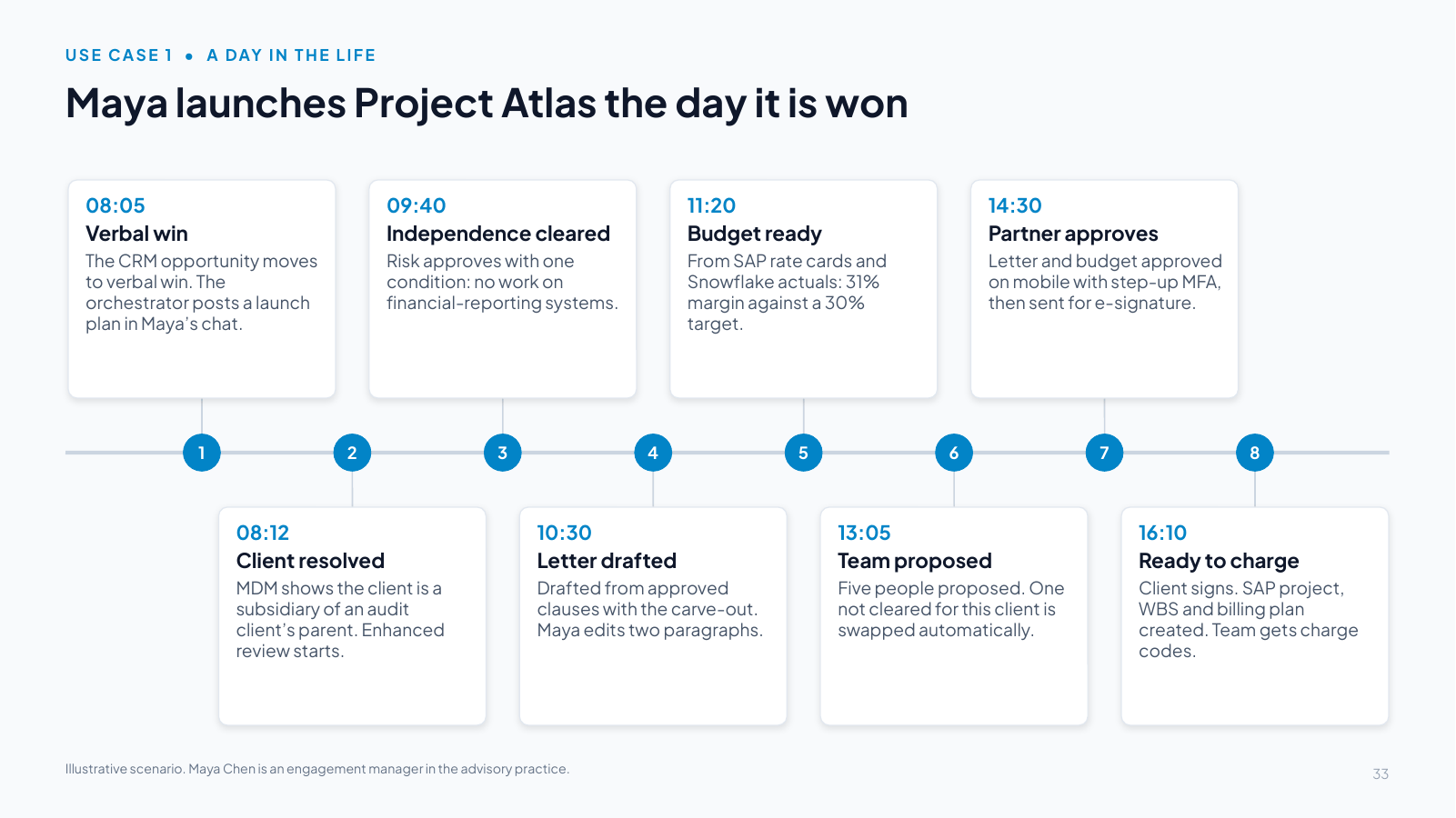
Maya launches Project Atlas the day it is won
Speaker notes
Tell Maya's day as a story.
At 08:05 the CRM opportunity for Project Atlas moves to verbal win, and within a minute Maya's chat copilot shows a launch plan targeting ready-to-charge in two days. By 08:12 the entity-resolution agent has matched the client to its golden record and found that it is a subsidiary of a group whose parent is an audit client, so an enhanced independence review starts automatically. At 09:40 a reviewer in Risk & Quality approves the engagement with one condition: no work on financial-reporting systems.
The scoping agent drafts the engagement letter with that carve-out by 10:30, and Maya rewrites two paragraphs. The pricing agent's budget arrives at 11:20 with a 31% margin against a 30% target. At 13:05 the staffing agent proposes a team of five, having already replaced a consultant who is not independence-cleared for this client. Maya sees only that a substitution was required, not why. The partner approves the letter and budget on mobile at 14:30 with step-up authentication, and the letter goes to the client for signature. At 16:10 the client signs, the setup agent creates the SAP project, WBS and billing plan, and the team receives charge codes.
End the story on the result: what used to take two weeks finished the same day, and every accountable decision was still made by a person.
How the components work together in Maya’s day
Speaker notes
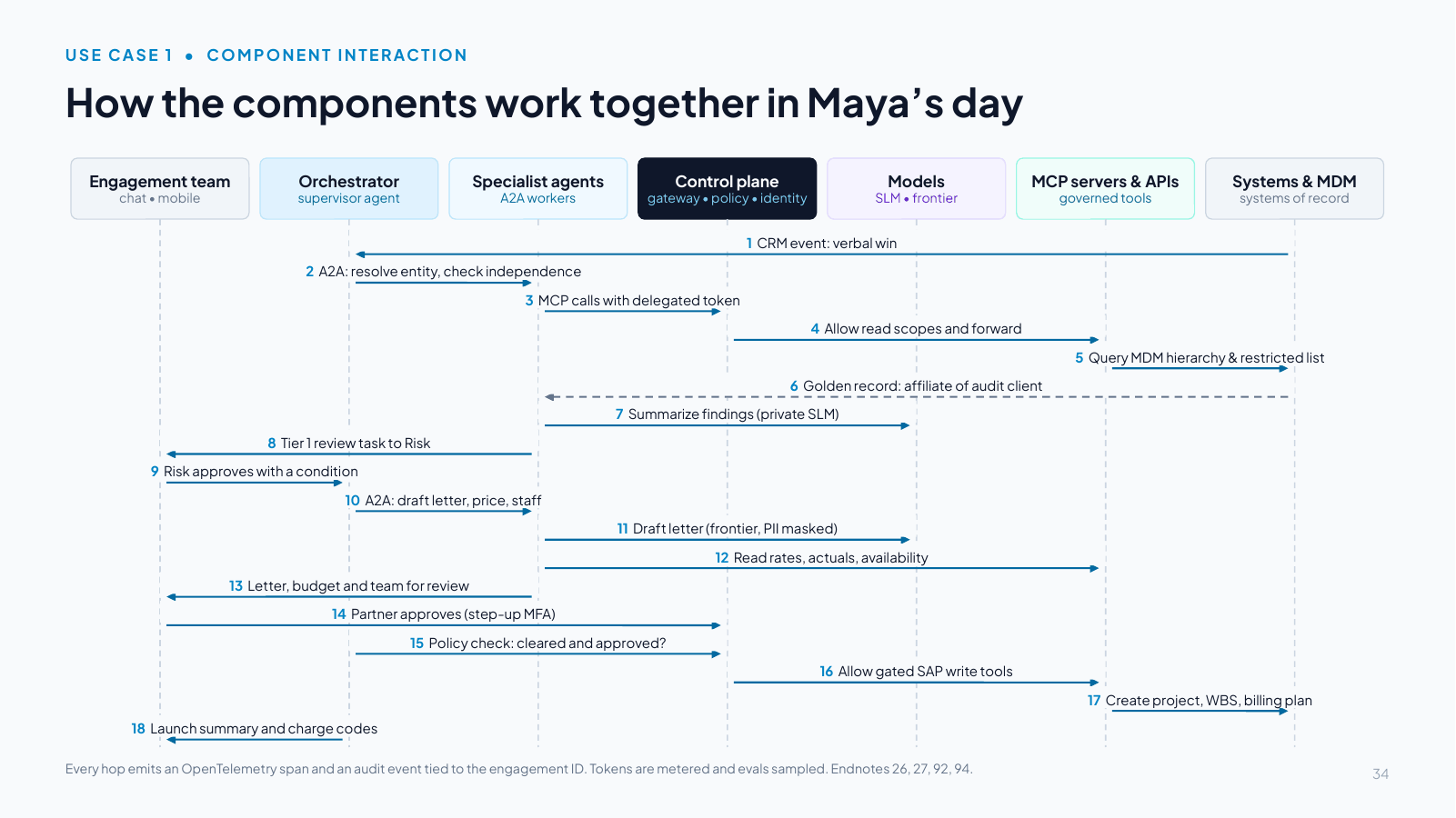
Read the numbered steps top to bottom. They follow Maya's day.
Steps 1–6 (08:05–08:12): the CRM event starts the orchestrator, which delegates entity resolution and the independence check over A2A [27]. The agent's MCP calls carry a delegated, on-behalf-of token [92], and the control plane authorizes read scopes only [26]. The MDM returns the golden record and flags the affiliate of an audit client, and lineage is captured.
Steps 7–9 (09:40): a private small language model summarizes the findings, and a Tier 1 review task goes to Risk & Quality. The decision is made there, never by the agent, and it is signed and logged.
Steps 10–13 (10:30–13:05): the orchestrator delegates drafting, pricing and staffing. Drafting uses the frontier model with personal data masked, and retrieval is filtered by information barriers. Rate cards, actuals and availability are read through MCP under row-access policies. Staffing sees only a yes/no clearance flag, never the underlying personal financial interests.
Steps 14–18 (14:30–16:10): the partner approves with step-up MFA, and the policy decision point confirms that the engagement is cleared, approved and signed. Only then does the gateway allow the SAP write tools, and the setup agent creates the project, WBS and billing plan with idempotent calls. The partner's approval is bound to the exact setup request and expires at the end of the business day.
Every hop emits an OpenTelemetry span and an audit event [94], tokens are metered against the launch budget, evaluations are sampled, and the kill switch is available throughout.
Realized with MuleSoft Agent Fabric and Informatica
Speaker notes
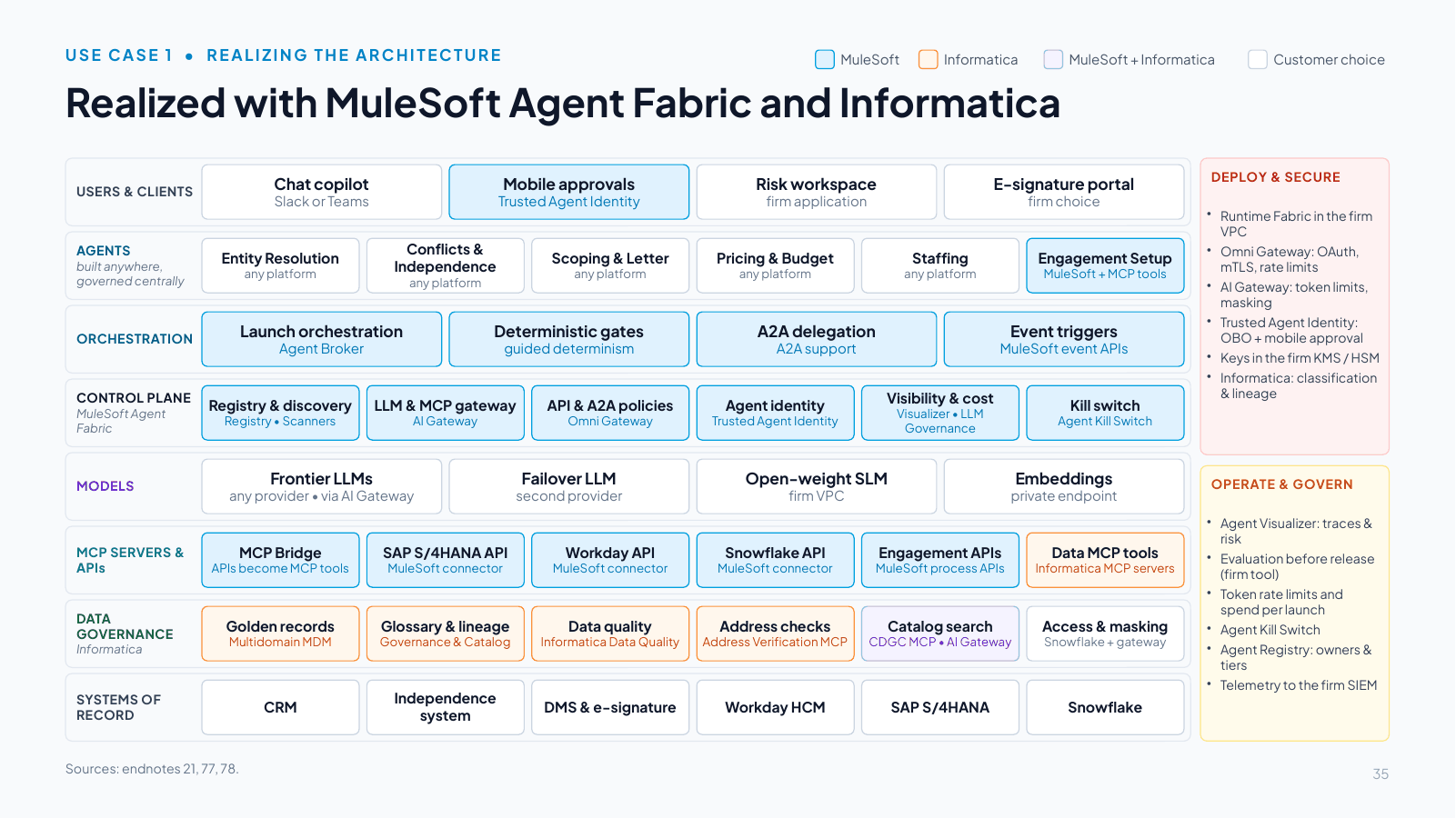
How MuleSoft Agent Fabric and Informatica realize the vendor-neutral design. Colors show which vendor fills each role. Grey boxes remain the firm's choice (collaboration tools, models, agent frameworks and systems of record).
- Registry and discovery: Agent Registry and Agent Scanners register every launch agent, including agents other teams built on other platforms, with owner and autonomy tier [21].
- Orchestration: Agent Broker with guided determinism enforces the fixed gates for independence, approvals and signature. A2A support handles delegation [21].
- Gateway: AI Gateway is the single policy point for LLM and MCP traffic (routing, token limits, masking). Omni Gateway applies authentication, mTLS and rate-limit policies to APIs and A2A [21][78].
- Identity and control: Trusted Agent Identity lets agents act on behalf of Maya or the partner, with mobile approval for high-risk steps [21]. A custom Omni Gateway policy, built with the Policy Development Kit, binds each approval to the executed call [78]. Agent Kill Switch, Agent Visualizer and AI cost controls (token-based rate limits and spend attribution) operate the system [21], and letters and findings are tested before release with the firm's evaluation tool.
- Tools: MCP Bridge turns existing APIs into governed MCP tools, and MuleSoft connectors reach SAP S/4HANA, Workday, Snowflake and the CRM without rewriting integrations [21].
- Data foundation (Informatica): Multidomain MDM provides client, worker and engagement golden records that agents reach through governed APIs, while data quality rules validate entity data at the point of entry and the Address Verification MCP server validates and standardizes addresses. Data Governance and Catalog gives agents and people a shared glossary and lineage, and agents find data assets through the CDGC Metadata Search MCP server [77].
- Deployment: Runtime Fabric keeps gateways and MCP servers inside the firm's VPC where confidentiality requires [21].
Expected business outcomes and KPIs
Speaker notes
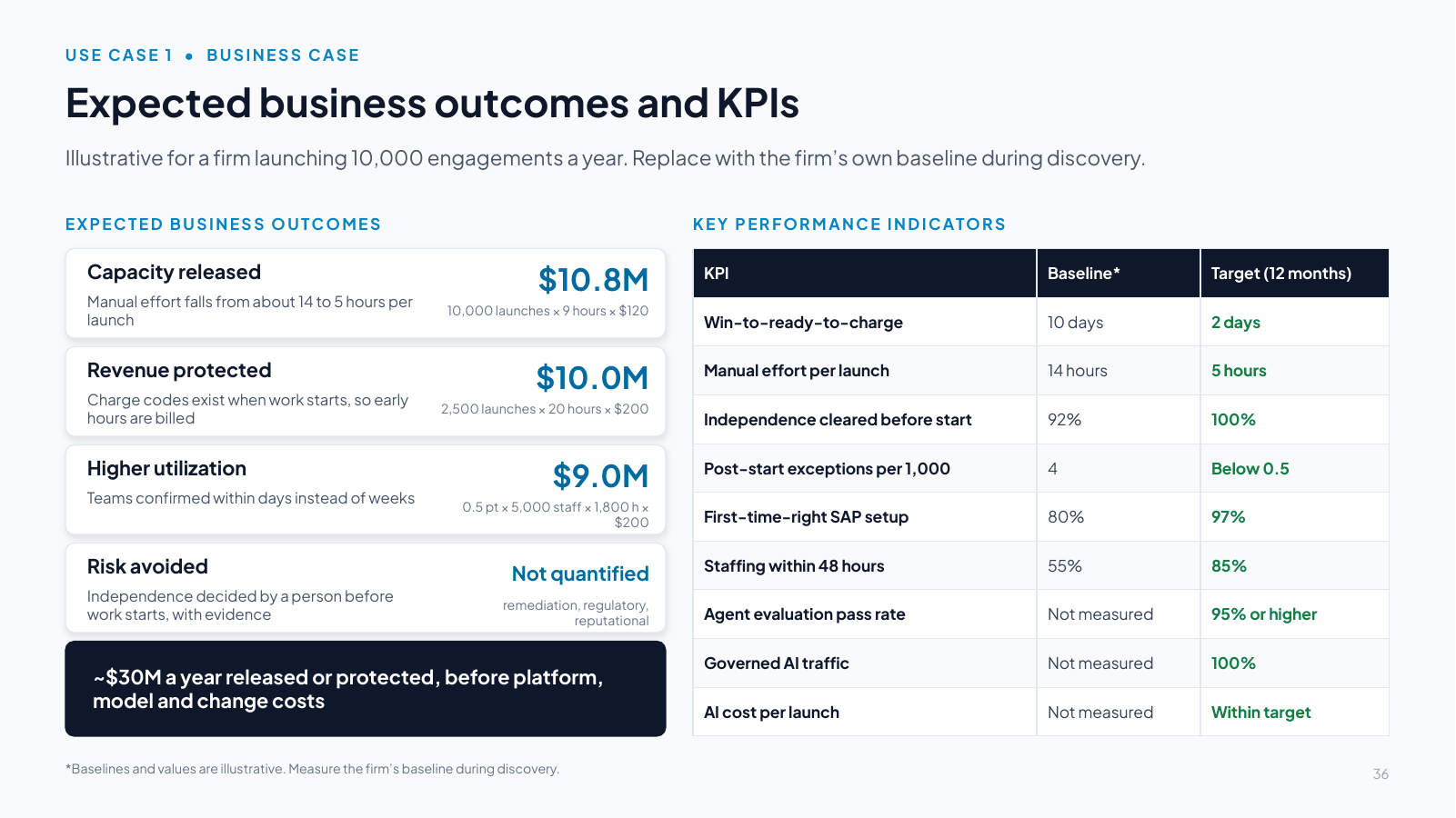
Business case, illustrative for a firm launching 10,000 engagements a year:
- Capacity released: manual assembly, checking and data entry falls from about 14 to 5 hours per launch across managers, Risk, resourcing and finance. 10,000 launches × 9 hours × $120 loaded cost is about $10.8M a year.
- Revenue protected: charge codes exist when work starts, so early hours are billed instead of written off. 2,500 affected launches × 20 hours × $200 average rate is about $10.0M.
- Higher utilization: teams are confirmed within days instead of weeks. 0.5 point × 5,000 client-facing staff × 1,800 hours × $200 is about $9.0M.
- Risk avoided: every independence decision is made by a person before work starts, with evidence and lineage. Not quantified.
Roughly $30M a year released or protected before platform, model and change costs, which should be estimated alongside the baseline.
Expected business outcomes: faster time to revenue (about two business days from verbal win to ready-to-charge), lower cost to launch, no known independence exceptions at engagement start, and a better client and staff experience.
KPIs: the baselines are illustrative. The KPIs that speak directly to the control plane are governed AI traffic (target: 100% of model and tool calls through the gateway) and AI cost per launch within target. Agent evaluation pass rate covers letter-clause accuracy and independence-finding recall.
Delivery plan and value by milestone
Speaker notes
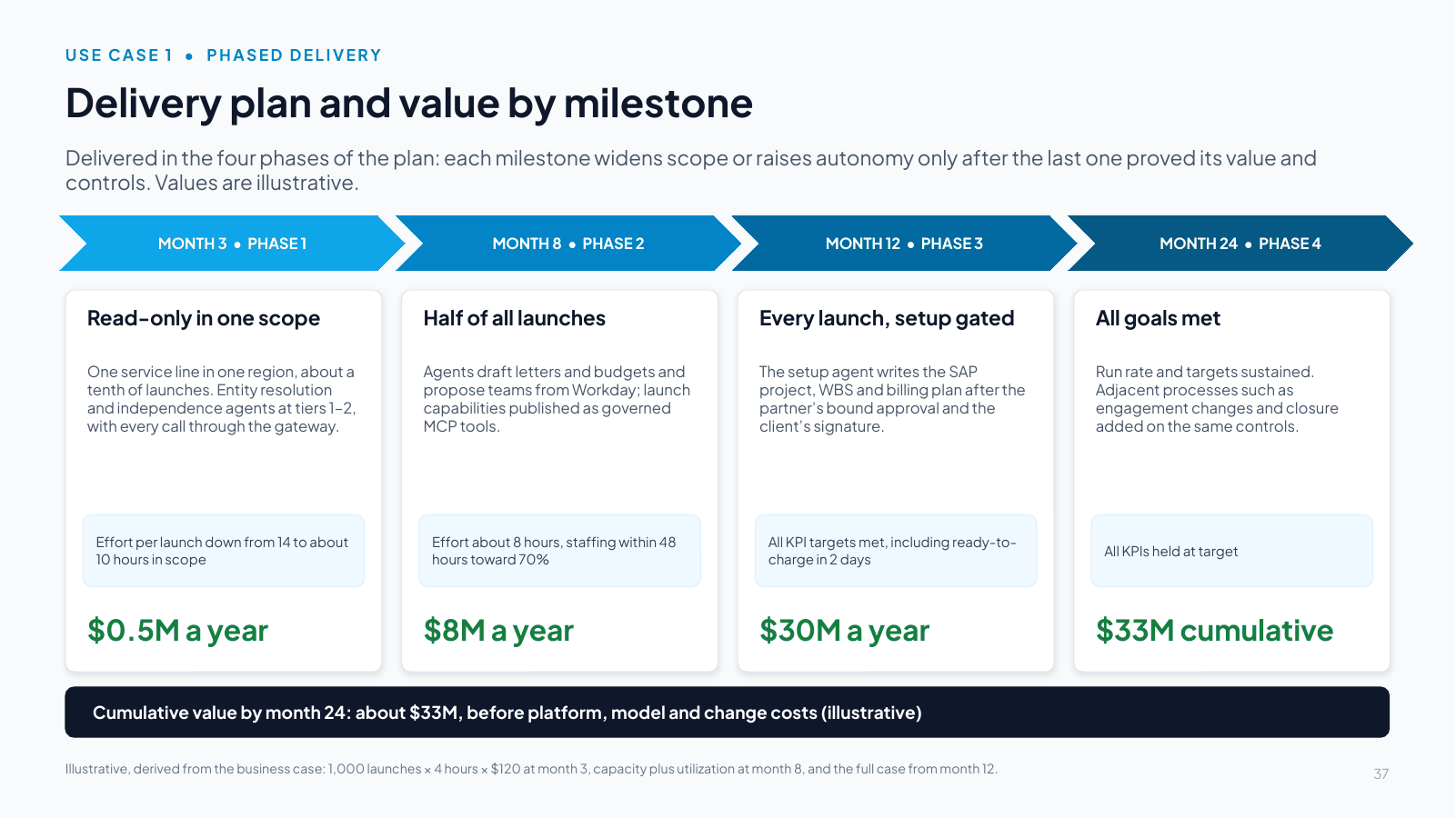
Phased delivery for the engagement-launch use case, aligned with the four phases of the plan. Each milestone widens the scope or raises the autonomy tier only after the previous one has proved its value and its controls.
- Month 3 (phase 1): one service line in one region, about a tenth of launches (1,000 a year). Entity resolution and independence agents work read-only at tiers 1–2, and every model and tool call goes through the gateway from day one. Effort per launch falls from 14 to about 10 hours in scope: 1,000 × 4 hours × $120 is about $0.5M a year.
- Month 8 (phase 2): half of all launches. Agents draft letters and budgets from approved clauses and rate cards, and the staffing agent proposes teams from Workday. Effort falls to about 8 hours (5,000 × 6 hours × $120, about $3.6M) and faster staffing lifts utilization by about a quarter point (about $4.5M): about $8M a year.
- Month 12 (phase 3): every launch. The setup agent writes the SAP project, WBS and billing plan at tier 3 once the partner's approval, bound to that exact request, and the client's signature are in place. All KPI targets are met and the full business case applies: about $30M a year.
- Month 24 (phase 4): run rate and targets sustained, with adjacent processes added on the same controls. Counting each run rate from the milestone at which it was reached, cumulative value by month 24 is about $33M.
All values are illustrative and before platform, model and change costs. The revenue protected by timely charge codes arrives in phase 3, when agents can write to SAP S/4HANA under bound approvals.
What the engagement-launch use case proves
Speaker notes
Wrap up with what this use case proves:
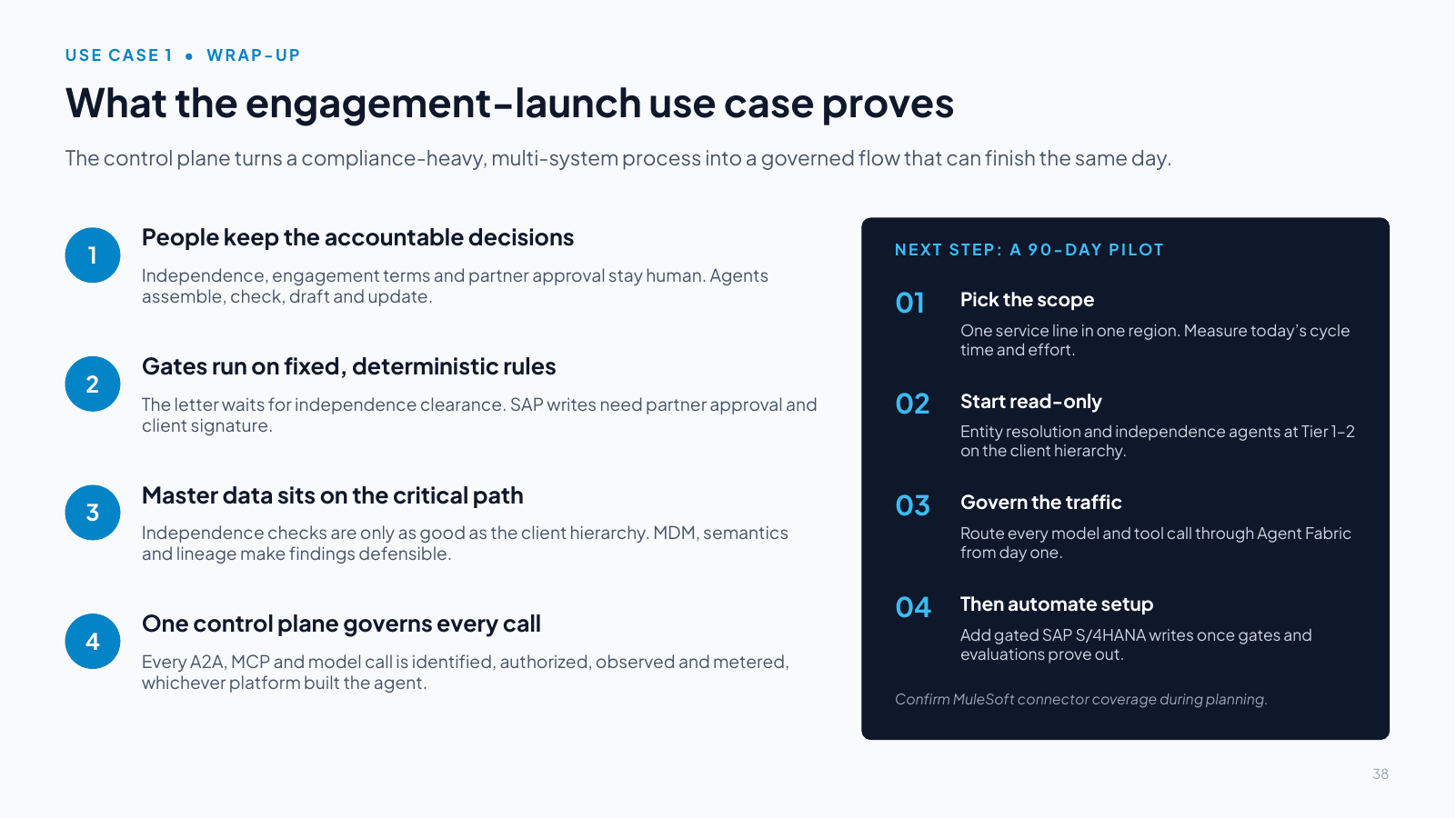
- People keep the accountable decisions. Independence decisions, engagement terms and partner approval stay human. Agents do the assembly, checking, drafting and system updates.
- Gates are deterministic. Model reasoning is used inside steps (resolving, summarizing, drafting, matching), never to skip a gate: no letter before independence is cleared, no SAP write before partner approval and client signature.
- Master data sits on the critical path. A missed subsidiary is a missed conflict, so golden records, semantics and lineage are what make independence findings defensible to inspectors.
- One control plane governs every call. Every A2A, MCP and model call is identified, authorized, observed and metered, whichever platform built the agent.
Proposed next step: a 90-day pilot. Scope one service line in one region and baseline today's cycle time and effort. Start read-only with the entity-resolution and independence agents at Tier 1–2. Route every model and tool call through Agent Fabric from day one. Add gated SAP S/4HANA writes only once the gates and evaluations prove out.
Before committing dates, confirm MuleSoft connector coverage for the firm's systems.