Section 8
A 12- to 24-month plan with value in every phase
Doubts about AI returns are well founded, which is why the reference architecture should be adopted in phases that each deliver returns. In a survey of more than 4,400 chief executives published in January 2026, 56% said AI had delivered no significant financial benefit to date.79 In a mid-2026 survey, 37% of respondents attributed any EBIT impact to AI,80 and many agentic AI projects are expected to be canceled over cost, unclear value or weak risk controls.6 The same research shows what the organizations that capture value do differently. Those with strong foundations are three times more likely to see meaningful financial returns.79 They build “a repeatable capability” instead of “simply accumulating tools or pilots,” and they redesign workflows around it.80 They also start small, embedding AI in adjacent processes, “demonstrating clear value, then scaling into core workflows,” with top performers moving from pilot to full implementation in about 90 days.81
This plan follows that pattern by adopting the reference architecture incrementally. Each phase switches on part of the control plane and, in the same window, puts a slice of a real use case into production, so value arrives from the first milestone while the platform matures. Because each phase proves its value before the next is funded, the program can be approved in stages instead of as a single 24-month commitment, with its return measured against actual platform, model and change costs as it goes.
The next 12 to 24 months are for architecting the controls, and finishing the agentic transition will take longer.1 The plan below works in a deliberate order. It establishes visibility and a single policy point first, opens up capabilities and routing next, then hardens trust and federates last. Published phasing guidance follows the same order, starting with governance, a single policy point and baseline guardrails and federating only at scale.20
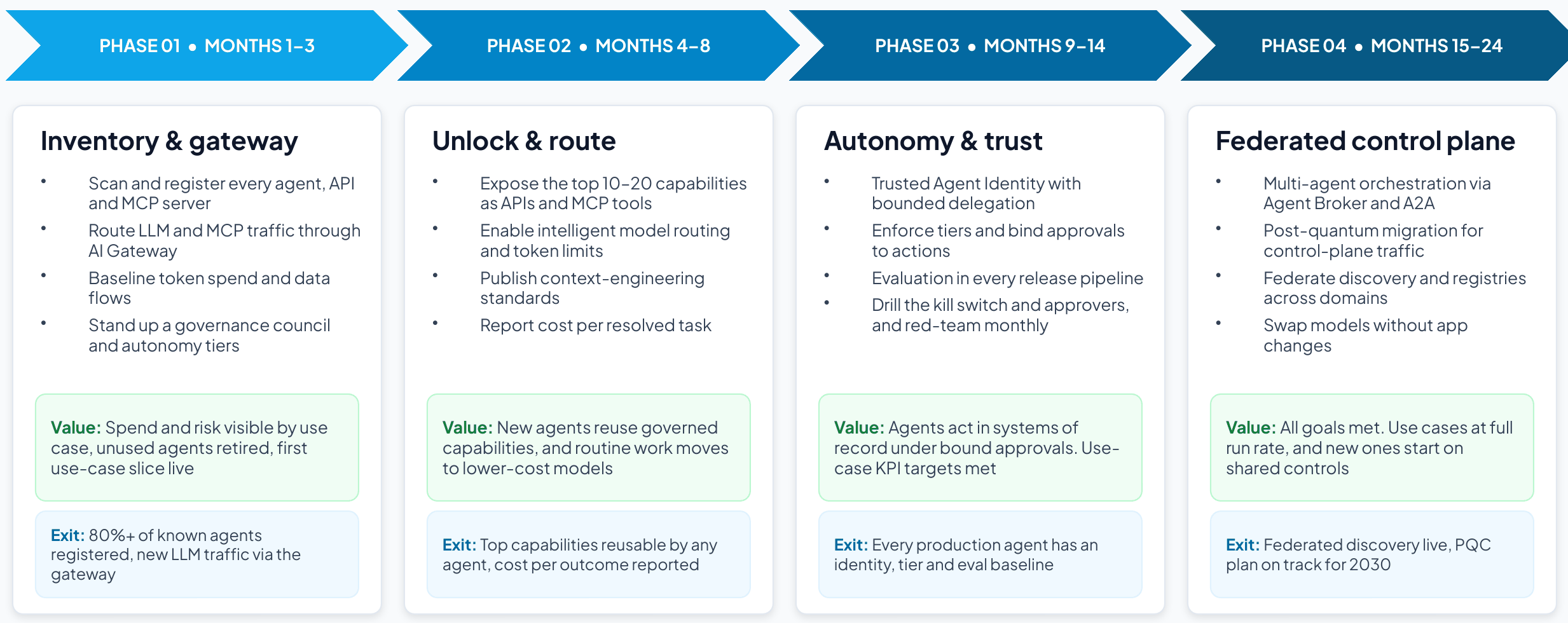
| Phase | Key actions | MuleSoft capabilities | Exit criteria |
|---|---|---|---|
| 1. Inventory and gateway (months 1–3) |
|
|
|
| 2. Unlock and route (months 4–8) |
|
|
|
| 3. Autonomy and trust (months 9–14) |
|
| Every production agent has an identity, a tier and an evaluation baseline |
| 4. Federated control plane (months 15–24) |
|
|
|
Value at every milestone
Each phase ends in a milestone the business can see. The architecture delivers value of its own, from spend visibility to faster delivery of every new agent, and each milestone brings more of a real use case into production. Report the evidence in the right-hand column at every steering review, where it feeds the scorecard in Section 9.
| Milestone | Value delivered | Evidence to report |
|---|---|---|
| Month 3: one front door |
|
|
| Month 8: reusable capabilities |
|
|
| Month 14: trusted autonomy |
|
|
| Month 24: north star reached |
|
|
Set these milestones against published payback data, because finance will compare them with it. In Deloitte’s 2025 survey of 1,854 executives in Europe and the Middle East, most achieved satisfactory ROI on a typical AI use case within two to four years, against the seven to 12 months expected of technology investments, while only 6% saw payback within a year and just 10% were realizing significant ROI from agentic AI.82 Expectations are shortening. In KPMG’s 2025 Global CEO Outlook, 67% of 1,350 CEOs expected returns on AI within one to three years, where a year earlier most expected three to five.83 Google Cloud’s 2026 survey of 2,403 executives found 84% seeing increasing financial returns from AI and 26% seeing returns accelerate year over year.84 Phasing lets a program beat that benchmark, because read-only and propose-only slices release capacity within months and help fund the controls that the larger gains depend on. The leaders in Deloitte’s survey judge generative and agentic AI differently, with 85% using different frameworks or timeframes for each.82 A program can do the same, judging the early slices over months and the agentic ones that act in systems of record over a longer horizon.
Phasing in the use cases
The same pattern works inside each use case. Start read-only in one scope, prove the value, widen the scope, and let agents act in systems of record once the controls from phase 3 are in place. The table shows the milestones for the three reference use cases in Sections 11 to 13. They come from different industries, so each column stands alone as an illustration and the columns should not be added up. Values are illustrative annual run rates at each milestone, before platform, model and change costs.
| Milestone | Use case 1: engagement launch | Use case 2: T+1 settlement | Use case 3: compressor reliability |
|---|---|---|---|
| Month 3 | Entity resolution and independence agents, read-only, for one service line in one region: about $0.5M a year | Fail scoring and exception triage for one market and asset class, analysts in the loop: about $0.8M a year | Condition monitoring and diagnostics on the historian replica for one segment of the fleet, advice only: about $0.4M a year |
| Month 8 | Letters, budgets and staffing proposals for half of all launches: about $8M a year | Triage across all markets, the SSI golden source fixed and fixes proposed for one-click approval: about $5.5M a year | Maintenance planning and crew and permit agents at all 40 stations, still with no changes to equipment: about $1.8M a year |
| Month 12 |
|
|
|
| Month 24: all goals met |
|
|
|
In all three, the early milestones release capacity from assembling, checking and drafting, which agents can do safely in read-only or propose-only modes. The larger gains, such as revenue protected by timely charge codes, automated settlement fixes and avoided outages, arrive once agents can act in systems of record under the approvals and limits that phase 3 puts in place. Sequencing each use case with the architecture keeps every step both valuable and safe.
Owners, decision rights and skills
BCG estimates that becoming AI-first “involves 30% technology and 70% people and organization.”85 In Microsoft’s 2026 Work Trend Index, a survey of 20,000 people using AI at work in 10 countries, only one in four said their leadership is clearly and consistently aligned on AI, and organizational factors accounted for more than twice the reported impact of individual ones.86 The organizations whose returns are accelerating set ownership deliberately, and in Google Cloud’s survey 48% of them had “extremely clear” ownership and decision rights for AI and agentic initiatives, while 38% built required AI training into roles.84 The plan’s accountable executive and governance council need a day-to-day model beneath them:
| Role | Owns | Decides |
|---|---|---|
| Accountable executive | The program, its funding and its business cases | Which phases and use cases proceed |
| AI governance council (architecture, security, risk, data, finance and the business) | Policy, autonomy tiers, standards and no-go zones |
|
| Business owner, per use case | Value, KPIs and the process agents work in |
|
| Agent sponsor, per agent | One agent from registration to retirement |
|
| Platform team (the control plane’s product owner) | Registry, gateway, identity, evaluation and observability services | Platform plan, shared policies and onboarding standards |
| Security and risk | Threat model, red-teaming and incident response |
|
| Finance | Cost attribution and value tracking |
|
Decide which work should stay human before deciding how to automate the rest. BCG suggests sorting work into human-led, AI-assisted and AI-led by asking two questions of each step: could AI do it as well as or better than people, and should it, given regulatory risk, customer trust, ethics and safety.85 Record the answer before any decision on roles, because Deloitte’s 2026 Human Capital Trends found that 57% of leaders who cut staff because of AI have come to question that decision.87 Build skills in step with the plan, training approvers on what they approve (Section 4), sponsors on the agent lifecycle (Section 2) and business teams on working alongside agents.
Where the plan ends
By the end of phase 4 the target reference architecture from Section 6 is in place, and every goal set at the start is met:
- Architecture. Every agent is registered with an owner and a tier, and all model, MCP and A2A traffic passes one policy point. The top business capabilities are reusable by any agent, and discovery and orchestration are federated across domains.
- Trust. Every production agent has an identity, a tier and an evaluation baseline, and high-risk actions execute exactly as approved. Drills show that people can stop an agent in time, and post-quantum migration is on track for 2030.
- Value. Each use case runs at its full run rate, with its KPI targets met since month 12. For the illustrative use cases, cumulative value by month 24 is about $33 million, $12 million and $3.8 million, before platform, model and change costs.
- Economics. Cost per outcome is falling, and models can be swapped without application changes when prices or providers change.