Cocaine dependence is hard to treat and the field has never settled which psychosocial approach works best. This trial randomized patients to four combinations of individual and group counselling and followed them for six months. Adding individual drug counselling helped at three months. By six months the advantage was gone.
Why this was studied
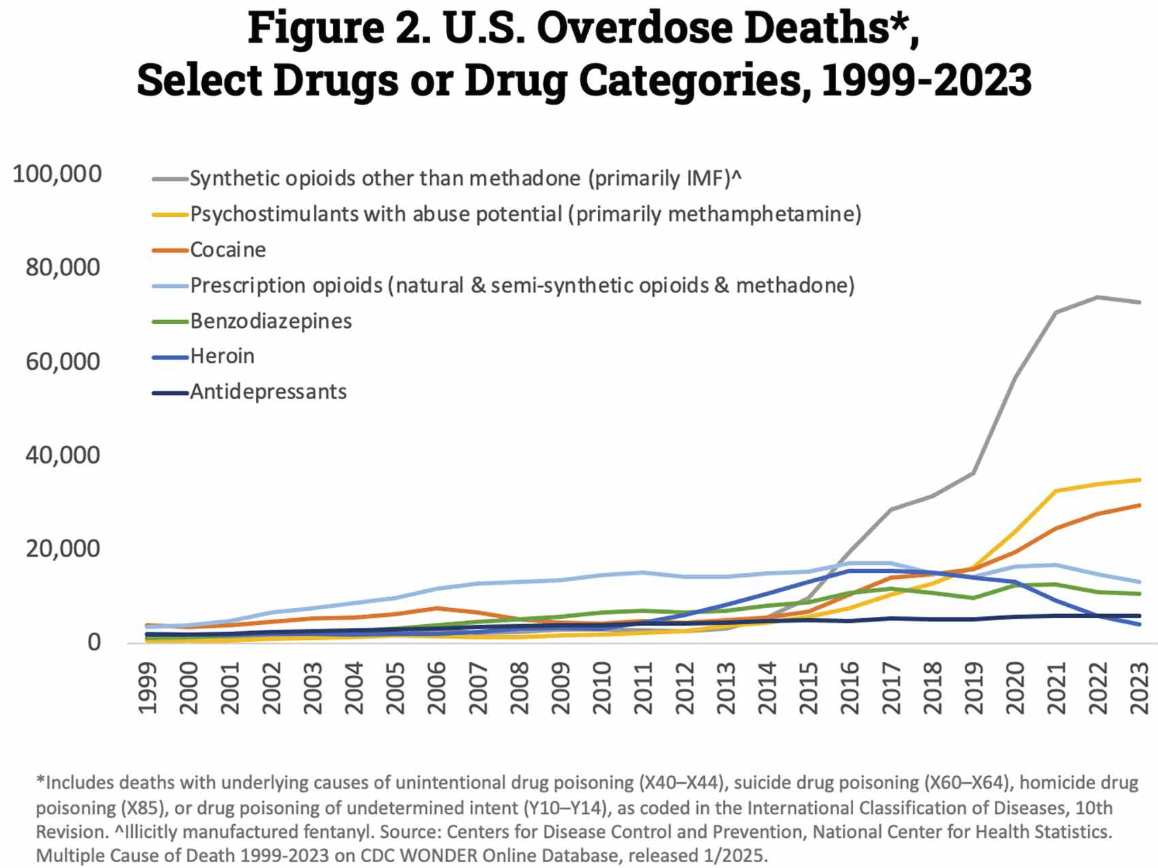
Cocaine overdose deaths in the United States were roughly flat through the 2000s, then climbed steeply from about 2015. By 2023 they sat near thirty thousand a year, on a par with the psychostimulant category and behind only synthetic opioids.
Treatment is the intervention point, and psychosocial treatment is the main option for cocaine dependence: there is no established pharmacotherapy. Which counselling approach works, and for whom, is therefore a live question rather than a settled one. This trial was designed to answer part of it.
The four arms
Every patient received group drug counselling. Three arms added an individual therapy on top of it, so the comparison is really "what does adding this individual therapy buy you over group counselling alone".
| Arm | What the patient received |
|---|---|
| GDC | Group drug counselling alone. The reference. |
| IDC+GDC | Individual drug counselling added |
| CT+GDC | Cognitive therapy added |
| SE+GDC | Supportive-expressive therapy added |
The outcome is the behaviour subscale of the Addiction Recovery Scale. Each model adjusts for the patient's own baseline score, so it asks who improved relative to where they started rather than who ended up highest.
How it was analysed
Months 3 and 6 are treated as separate cross-sections and analysed by analysis of covariance. ANCOVA is the right tool here because patients did not all start in the same place: adjusting for the baseline score compares like with like rather than rewarding the arm that happened to draw healthier patients.
Three further steps follow. Two-way and three-way models add gender and race to test whether a treatment works differently for different patients. A repeated-measures model uses both timepoints together. And the modelling assumptions, normality of residuals and equality of variance across arms, are checked rather than assumed.
What was found
At month 3 the arms differ (p = .0110), and the difference is carried by individual drug counselling. By month 6 there is no detectable difference between arms at all (p = .2580). The baseline score is by far the strongest predictor at both timepoints, which is usual in this kind of trial and worth saying plainly: where a patient starts predicts where they land better than which therapy they were assigned.
An effect at three months that is absent at six can mean the benefit faded, or that the patients still being measured at six months are a different group. Both are live possibilities here, and the analysis takes them seriously rather than picking one.
Where to go next
The analysis
Both models with intervals, retention, assumption checks, and the subgroup findings with their cell sizes.
LiveAbout the data
This analysis uses patient-level data from the NIDA Collaborative Cocaine Treatment Study. That data is not published here and is not redistributable. It contains clinical, psychiatric and substance-use measures on identifiable-by-number patients at named treating institutions.
Everything on this site is aggregate: model output, adjusted means, test statistics and counts. Nothing that could return an individual patient record appears anywhere in this repository.