One Teaching Method Pulls Ahead, and Two Are Tied
Flipped instruction beat both alternatives by about eight exam points; Lecture and Blended performed the same.
Recommendation
Expand the Flipped format, and treat Lecture and Blended as interchangeable on exam performance. Flipped students scored about 8 points higher on the final than students in either other format, a gap far too consistent to be chance. Before committing, confirm that students did not choose their own section, because self-selection would produce this same result without the format doing any of the work.
What we found
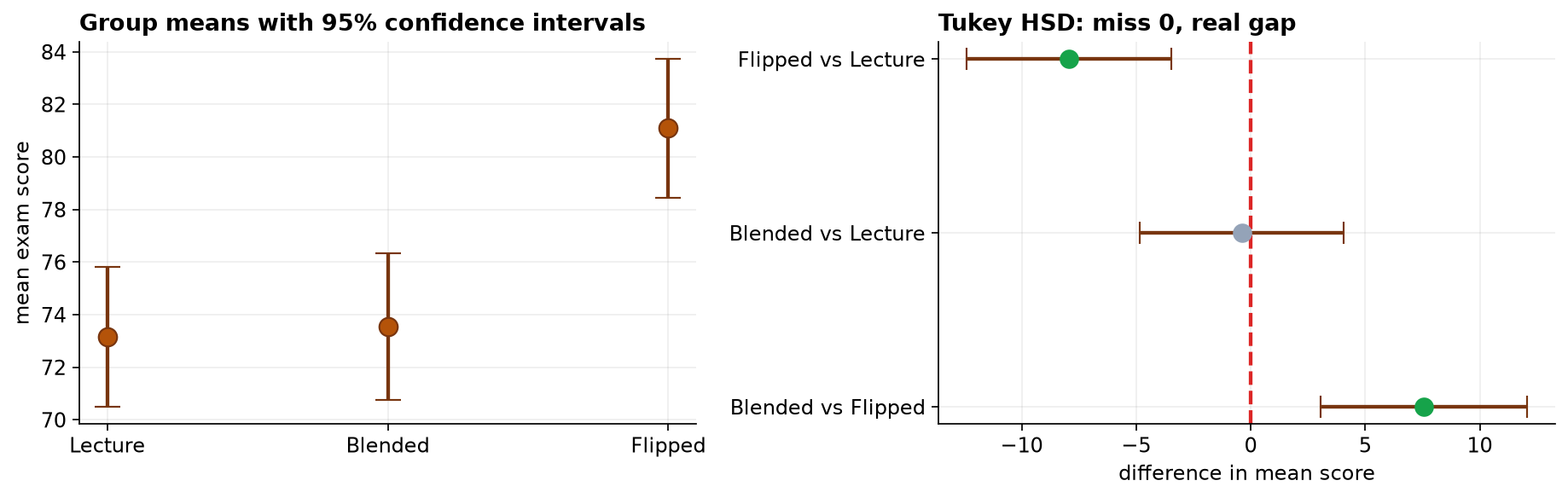
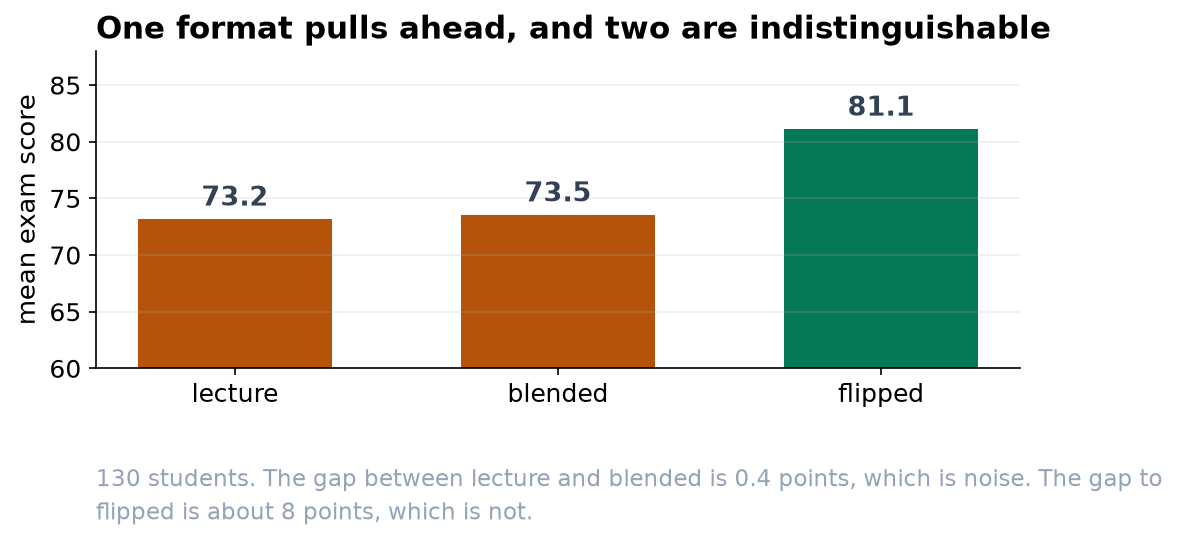
We compared final exam scores for 130 students across three formats. Lecture averaged 73.2, Blended 73.5, and Flipped 81.1. The overall test says the three are not alike (p is well under 0.001), and the follow-up comparison locates the difference precisely: Flipped beats Lecture by about 7.6 points and Blended by about 7.9 points, while Lecture and Blended sit within half a point of each other.
Why the two-part answer matters
It would be easy to report only that 'teaching method made a significant difference'. That sentence is true and misleading. It invites the reader to assume all three formats differ, when in fact two of them performed identically. The actionable finding is narrower and more useful: one format helps, and choosing between the other two on exam grounds alone is a coin flip.
How much of the story is method?
Teaching format explains roughly 15% of the variation in exam scores. That is a substantial share for an educational intervention, but it also means the large majority of the difference between students comes from everything else, prior preparation, effort, and circumstance. Adopting Flipped should be expected to shift the average, not to level the class.
Before you act on this
Two cautions. First, and most important, this only supports a claim about the format if students were assigned to sections rather than choosing them; if the Flipped sections attracted more motivated students, we are measuring the students. Second, instructor and format are entangled here, so if one instructor taught all the Flipped sections we cannot separate the two. A follow-up that rotates instructors across formats would settle both questions.